Showing posts with label Comparative religion....and atheism. Show all posts

Saturday, August 24, 2013

August 2013 - Jesus in India

And excellent and enlightening read...

Raziya


Email not displaying correctly? View it in your browser.
Al Islam eGazette
Jesus in India: A Book from 1899
By Hazrat Mirza Ghulam Ahmad Qadiani (peace be upon him)
Jesus in India is an English version of Masih Hindustan mein, an Urdu treatise written by the Holy Founder of the Ahmadiyya Movement in Islam, Hazrat Mirza Ghulam Ahmad (1835 - 1908). The Urdu treatise was published in 1899.
The main thesis expounded in the treatise is Jesus' escape from an ignominious death on the Cross and his subsequent journey to India in quest of the lost tribes of Israel whom he had to gather into his fold as mentioned in the New Testament.
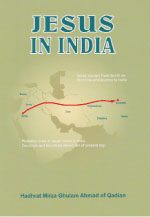
Abundant evidence has been furnished from Christian as well as Muslim Scriptures, old medical books and books of history, including ancient Buddhist records, to illustrate the theme.
Starting upon his journey from Jerusalem and passing from thence through Nasibus and Iran, Jesus is shown to have reached Afghanistan, where he met the Jews who had settled there after their deliverance from the bondage of Nebuchadnezzar.
From Afghanistan Jesus went to Kashmir, where some Israelite tribes had also settled. He made this place his home and here he died. His tomb has been traced and found in Khanyar Street, Srinagar.
To read the full book click here

Jesus in India Exhibit in Canada
Ahmadiyya Muslim Community Canada held the Exhibition in downtown Toronto, about the theme of Jesus in India on July 11, 2013.
About 150 guests visited the Exhibit, in City Hall Toronto and 40 of them studied the displays in some detail and asked questions and were intrigued by the information.
Human memory leads to the illusion-of-truth effect, meaning that we are more likely to rate those statements true that we are familiar with, regardless of their veracity. As such familiarity impairs judgment and prevents people from noticing let alone accepting the obvious limitations in their views.
Familiar seems true and unfamiliar, however logical and rational, seems fictional.
A few guests expressed their displeasure about the concept that Jesus had survived crucifixion and migrated to India.

If Jesus did not die upon the cross: A study in evidence, is a small booklet with a very descriptive title, written by an Australian Judge, Ernest Brougham Docker, in 1920. He became a judge of the District Court and chairman of Quarter Sessions for the north-western district in 1881. He retired in 1918 after the passage of the Judges Retirement Act.
Ernest Brougham Docker writes in the fourteenth chapter of his short book:
But I must here notice the old legend which I have before referred to. A modern version of it was given in the periodical The East and the West some years ago. Briefly, it is to the effect that Jesus did not die on the cross, but recovered under treatment, a miraculous ointment being applied to His wounds, which healed in the space of forty days; that He journeyed to India to preach to the lost tribes of Israel; and eventually died at Srinagar, where a tomb is pointed out to this day as His.
Though I do not know of any evidence tending to establish the substantial truth of this account, I desire to point out that there is nothing unreason-able or improbable about it. We are told from other sources that there are to the present day in Afghanistan and Bactria tribes of unmistakable Hebrew type. It is surprising to find the number of passages in the New Testament writings which, if they do not corroborate the story, at least are consonant with it. Is it unreasonable then to suppose that Jesus, finding it unsafe to remain in Judaea or Galilee longer than the forty days during which He is said to have instructed His disciples in the things concerning the Kingdom of God (Acts i. 3), should feel called to carry the message of the Kingdom to the lost tribes of the House of Israel?
To read his book click here

Dan Barker's Challenge to Every Christian about Resurrection and Ascension
Dan Barker (born June 25, 1949) is a prominent American atheist activist who served as a Christian preacher and musician for 19 years but left Christianity in 1984. Read his biography further in Wikipedia.
He issues a simple challenge to all of us, Christian or not, in his book, Losing Faith in Faith: From Preacher to Atheist:
The conditions of the challenge are simple and reasonable. In each of the Gospels, begin at Easter morning and read to the end of the book: Matthew 28, Mark 16, Luke 24, and John 20-21. Also read Acts 1:3-12 and Paul's version of the story in 1 Corinthians 15:3-8. These 165 verses can be read in a few moments. Then, without omitting a single detail from these separate accounts, write a simple, chronological narrative of the events between the resurrection and the ascension: what happened first, second, and so on; who said what, when; and where these things happened.
Since the gospels do not always give precise times of day, it is permissible to make educated guesses. The narrative does not have to pretend to present a perfect picture-it only needs to give at least one plausible account of all of the facts. Additional explanation of the narrative may be set apart in parentheses. The important condition to the challenge, however, is that not one single biblical detail be omitted. Fair enough?
I have tried this challenge myself. I failed. An Assembly of God minister whom I was debating a couple of years ago on a Florida radio show loudly proclaimed over the air that he would send me the narrative in a few days. I am still waiting. After my debate at the University of Wisconsin, 'Jesus of Nazareth: Messiah or Myth,' a Lutheran graduate student told me he accepted the challenge and would be contacting me in about a week. I have never heard from him. Both of these people, and others, agreed that the request was reasonable and crucial. May be they are slow readers.
To read further click here

The Most Popular Video in the Muslim Times: Govt of India Documentary on Jesus in Kashmir!
Epigraph: "And We (Allah) made the son of Mary and his mother a Sign, and gave them refuge on an elevated land of green valleys and springs of running water." (Al Quran 23:51)
Tomb of Jesus in Srinagar, Kashmir
If I say Jesus, may peace be on him, died of natural causes, it would appear strange to many ears, even though when the same is said about billions of other humans, it seems but obvious, and is taken for granted.
Sir Francis Bacon, who has remained extremely influential through his works, especially as philosophical advocate and practitioner of the scientific method during the scientific revolution, once advised, "Read not to contradict ... but to weigh and consider." I would invite everyone of Christian background to view the following video and read the materials provided with this premise, please.
Human memory leads to the illusion-of-truth effect, meaning that we are more likely to rate those statements true that we are familiar with, regardless of their veracity. As such familiarity impairs judgment and prevents people from noticing let alone accepting the obvious limitations in their views.
Familiar seems true and unfamiliar, however logical and rational, seems fictional.
With this prelude we invite you, to a 53 minute documentary, produced by the government of India showing how Jesus came to India to teach Dharma or religion. This video has been the most popular in the video section of the Muslim Times.
To watch the video click here

August 2013

Updates from Alislam
What's New at alislam.org
Follow us on
Twitter YouTube
Facebook Google+
Recent Highlights
Jalsa Salana Germany 2013 Videos Including Addresses by Hazrat Khalifatul Masih V
Khutbaat-e-Mahmood Volume 17 to 25 (Year 1936 to 1944) Friday Sermons by Hazrat Musleh Maud (ra)
Anwarul 'Ulum (Volume 20 to 23) Books by Hazrat Musleh Maud (ra)
6 new eBooks (epub) Available on Kindle, iBooks and other platforms
Persecution News and Updates
For latest updates about the persecution of peaceful Ahmadiyya Muslim Community please visit newly launched website www.persecutionofahmadis.org


Jesus and Mary are loved by Muslims too
By: Laiq Ahmed Atif, President Ahmadiyya Muslim Community, Malta
Each year, with the start of December, many discussions, publications, activities are directly focused on the topic of 'Christmas'; in brief, Christmas becomes the talk of the town. Streets become brighter with different lights and decorations; homes, shops and offices are also very well decorated, in order to welcome Christmas.
The Holy Quran gives great honor and respect to Jesus and Mary (peace be on them), and both are mentioned repeatedly in the Holy Quran. A chapter of the Holy Quran is named after mother Mary and the name of Jesus is actually mentioned more often in the Holy Quran than of the Holy Prophet Muhammad, may peace be on him. Allah Almighty says:
When the angels said, 'O Mary, Allah gives thee glad tidings of a word from Him; his name shall be the Messiah, Jesus, son of Mary, honored in this world and in the next, and of those who are granted nearness to God. (3:46)
And We gave Jesus, son of Mary, clear proofs and strengthened him with the Spirit of holiness. (2:254)
The Holy Quran also extended great honor and respect to Mary, to such a high extent that God has named an entire chapter of the Holy Quran by her name, 'Sura Maryam', and Maryam is an Arabic name for Mary. The Holy Quran speaks of her righteousness and states:
And remember when the angels said, 'O Mary, Allah has chosen thee and purified thee and chosen thee above the women of all peoples. (3:43)
The Holy Quran also mentioned about her piety and God cleared her from allegations which were raised against her, by the people of the time. It states that:
"Then she brought him (Jesus) to her people, carrying him. They said, 'O Mary, thou hast brought forth a strange thing. (19:28)
Furthermore:
And the example of Mary, the daughter of 'Imran, who guarded her private parts - so We breathed into him of Our Spirit - and she fulfilled in her person the words of her Lord and His Books and was one of the obedient." (66:13)
And We made the son of Mary and his mother a Sign, and gave them refuge on an elevated land of green valleys and springs of running water. (23:51)
These verses, just to mention a few, are clear evident to the reality that Islam pays a great honor, respect and dignity to beloved Jesus and Mary (peace be on them). And having affection and respect for such great and noble personalities and to follow their footsteps is part and parcel of Islamic faith. Christmas is a time to remember the work and accomplishment of Jesus; it is a reminder for following their footsteps.
To read more click here

A Muslim Honors National Bible Week
Source / Courtesy: The Huffington Post
By Harris Zafar
For those who may not know, we are in the midst of National Bible Week, sponsored by the National Bible Association. This is a week, especially identified to raise awareness of the Bible's importance and relevance to the nation and the lives of individuals. During this week, Christians are encouraged to read and study the bible in greater detail. But Christians aren't the only ones who can benefit from it, right?
As an American Muslim, I fully support the goal and purpose of National Bible Week. It may sound strange tohear a Muslim honoring National Bible Week, but I'm not the only one. The Ahmadiyya Muslim Community - the oldest Muslim organization in America - supports this week and calls on Americans to join together in this cause of reading and studying the Bible. This is just part of the effort the Ahmadiyya Muslim Community has waged all year long, which is why we have hosted many interfaith symposia throughout the year all over the country on the topic of "sanctity of holy scriptures," where we advocate for respect and honor to all Holy Scriptures.
To read more click here

Foundation of our morality: Islamic and Judeo-Christian tradition!
Collected by Zia H Shah MD
If we examine our morality in its extreme situations we may realise that clearly there are religious implications and our morality came from God and perhaps cannot fully exist without God.
Our morality is rooted in the prophets of God who revealed to us the absolute standards of our Creator against murder and incest for example.
If we carefully examine the teachings of the Bible and the Holy Quran on the subject of murder and incest we will find Quranic tradition a more evolved and preserved text. The Holy Quran details the blood relationships that believers are forbade to marry. It says:
"Forbidden to you are your mothers, and your daughters, and your sisters, and your fathers' sisters, and your mothers' sisters, and brother's daughters, and sister's daughters, and your foster-mothers that have given you suck, and your foster-sisters, and the mothers of your wives, and your stepdaughters, who are your wards by your wives unto whom you have gone in - but if you have not gone in unto them, there shall be no sin upon you - and the wives of your sons that are from your loins; and it is forbidden to you to have two sisters together in marriage, except what has already passed; surely, Allah is Most Forgiving, Merciful." (Al Quran 4:24)
About murder the Quran links itself to the Jewish tradition and states:
"... On account of this, We prescribed for the children of Israel that whosoever killed a person - unless it be for killing a person or for creating disorder in the land - it shall be as if he had killed all mankind; and whoso gave life to one, it shall be as if he had given life to all mankind. And Our Messengers came to them with clear Signs, yet even after that, many of them commit excesses in the land." (Al Quran 5:33)
To read more click here

Unsubscribe    |   Contact Us   |   eGazette Team   |   Sitemap    |   Twitter   |   Facebook   |   Google+   |   YouTube
Copyright © 2013 Ahmadiyya Muslim Community. All rights reserved.
--
​'One learned man is harder on the devil than a thousand ignorant worshipers': Prophet Muhammad (pbuh)

Monday, June 24, 2013

John the Baptist Day: The Quran and the Bible

Follow us in Twitter | The Muslim Times | AlislamSubscribe                          

John the Baptist Day: The Quran and the Bible
Epigraph:
'O Yahya (John the Baptist), hold fast the Book.' And We gave him wisdom while yet a child, and tenderness of heart from Ourself, and purity. And he was pious and dutiful toward his parents. And he was not haughty and rebellious.  And peace was on him the day he was born, and the day he died, and peace there will be on him the day he will be raised up to life again.  (Al Quran 19:13-16)
Truly I tell you, among those born of women there has not risen anyone greater than John the Baptist.  (Matthew 11:11)
John the Baptist is baptizing Jesus, painting by Guido Reni, John the Baptist is shown as a towering figure, over-shadowing Jesus

Written and collected by Zia H Shah MD
Saint John the Baptist Day marks the birth of St John on June 24 each year. It is a public holiday in the autonomous community of Catalonia in Spain.
The Holy Quran paints a picture of John the Baptist, may peace be on him, entirely consistent with its theology but the same cannot be said about the account in the Gospels and the Christian theology.
Saint John the Baptist Day is a public holiday in the autonomous community of Catalonia on June 24. Public life is generally quiet. Most businesses and other organizations are closed. Most stores are closed but some bakers and food stores may be open. Public transport services generally run to a reduced schedule, although there may be no services in rural areas.
St John was a preacher and religious figure during Jesus' lifetime, according to the Christian belief. Baptism rituals in the Jordan River were an important part of his ministry.
John the Baptist is the patron saint of many villages, towns and regions, including Catalonia. The Saint John the Baptist Eve and Day celebrations have their origin in ancient Midsummer solstice celebrations. These are reflected in the use of fire, water and certain herbs in the celebrations.[1]
The Holy Quran presents him as a Jewish prophet among the chain of prophets and it is entirely consistent with the Quranic theology that there are no regions of the world, where prophets were not sent by God to guide mankind.
One obvious dilemma created by the person of John the Baptist is that a person of higher religious standing baptizes a person, who is junior to him.  So, if John the Baptist baptized Jesus, in spiritual realm he had a status higher than Jesus?  If this be true it takes away from the theory of Jesus, may peace be on him, being literal son of God!  We read in the Gospel of Matthew:
Then Jesus came from Galilee to the Jordan to be baptized by John. But John tried to deter him, saying, 'I need to be baptized by you, and do you come to me?'
Jesus replied, 'Let it be so now; it is proper for us to do this to fulfill all righteousness.' Then John consented. (Matthew 3:13-15)
John the Baptist is baptizing Jesus, presumably taking a superior role and not declaring his faith in 'son of God,' who has come to 'die for sins of humanity,' including those of John the Baptist's, if any, and his followers.  He continues with his ministry rather than yielding to the alleged son of God!
According to Encyclopedia Britannica, "All four Gospels recognize in John the start of the Christian Era, and each in its own way tries to reconcile John's precedence in time and Jesus' acceptance of his message and of a baptism of repentance from his hands (elements suggesting subordination to John), with the author's belief in Jesus as Messiah and son of God." [2] 
The myth making of Gospel of Luke knows no bounds, even in his mother's womb John recognizes Jesus—also still in his mother's womb—as his Lord. (Luke 1:39-45)   Yet in the Gospel of Matthew we read that John the Baptist is not sure about the status of Jesus, just a few years before crucifixion and sends his followers to make queries:
When John, who was in prison, heard about the deeds of the Messiah, he sent his disciples to ask him, 'Are you the one who is to come, or should we expect someone else?'
Jesus replied, 'Go back and report to John what you hear and see:  The blind receive sight, the lame walk, those who have leprosy are cleansed, the deaf hear, the dead are raised, and the good news is proclaimed to the poor. Blessed is anyone who does not stumble on account of me.'
Truly I tell you, among those born of women there has not risen anyone greater than John the Baptist.  (Matthew 11:2-11)
John the Baptist does not get to hear the story about his grandeur as his followers had left before Jesus praised him, but Jesus' followers are told that John the Baptist is the greatest of all.  Presumably he is greater than Jesus also as he was born of Mother Mary.
No reason is offered as to why John the Baptist is greater than the Prophet Abraham or the Prophet Moses, who are the Founding Fathers of Judaism, in their own right, even though centuries apart?
It is strange that according to St. Paul a new religion is being launched in Jesus dying for the sins of humanity, yet both Jesus and John the Baptist are living the lives of Jewish prophets and both are circumcised and continue to follow other Jewish ethics, according to the Gospels.
According to St. Paul a new Covenant is being signed between God and His people but through out the lifetime of Jesus, there is no mention of the new Covenant, he and his followers are practicing the old Jewish Covenant every day of the week, even as Jesus prays passionately to God the Father, for the bitter cup to be taken away from him.  He himself is circumcised and so is everyone of his followers and the person who baptizes him, until St. Paul signs a new deal more than 20 years after crucifixion, to ease pagan's conversion to Christianity.
So, much for a new Covenant!
The external sign of the old Covenant, which is circumcision, is being practiced universally, until decades after crucifixion or the new Covenant, in the new Christian communities.
Interestingly, in reading the account of John the Baptist in the Gospels, we do find a mention of the Holy Prophet Muhammad, as 'the Prophet.'  We read in the Gospel of John:
Now this was John's testimony when the Jewish leaders in Jerusalem sent priests and Levites to ask him who he was. He did not fail to confess, but confessed freely, 'I am not the Messiah.'
They asked him, 'Then who are you? Are you Elijah?'
He said, 'I am not.'
'Are you the Prophet?'
He answered, 'No.' (John 1:19-21)
Incidentally, here we have another of the contradictions in the Bible, as John the Baptist refuses to be Elijah, but, Jesus calls him the Elijah. (Matthew 11:13-15)
At any rate, what is of greater interest in this account of the first chapter of Gospel of John, is the expression, 'the Prophet,' which is separate from Elijah or the Messiah and can most fittingly be applied only to the Holy Prophet Muhammad, may peace be on him.
On this holy day, let me extend an invitation to the two billion Christians that as we study the account of John the Baptist, in both the Holy Quran and the Holy Bible, as we celebrate his day, to try to compare and contrast the two theologies with the goal to find common themes.  Let me conclude in the words of the Holy Quran:
Say, 'O People of the Book! come to a word equal between us and you — that we worship none but Allah, and that we associate no partner with Him, and that some of us take not others for Lords beside Allah.' But if they turn away, then say, 'Bear witness that we have submitted to God.' (Al Quran 3:65)


The Muslim Times' Editorial team: If you like what you see, please forward it to friends and family.  To know more about us: click here.
1-800-WHY-ISLAM

Monday, April 29, 2013

David Versus Goliath: Dawkins, McGrath or Me – Who is the Most Rational? (Part I)

The Muslim Times | AlislamSubscribe

David Versus Goliath: Dawkins, McGrath or Me – Who is the Most Rational? (Part I)

Epigraph:  
"When it is not in our power to determine what is true, we ought to follow what is most probable." René Descartes


Prof. Richard Dawkins is facing Prof. Alister McGrath, who is in full view
Written and collected by Zia H Shah MD
In this debate or interview, the parties did not invite a Muslim, as is often the case with the Western scholars, despite the fact that God of Islam was frequently hijacked by Prof. Alister McGrath and often point of criticism by Prof. Richard Dawkins.
Why do I say that Islam was frequently hijacked by McGrath?
Many of the current Christian concepts are borrowed from Islam, without due acknowledgement.  I will give only two examples here.  Firstly, the pragmatic approach towards the offending party, rather than always turning the other cheek, which has become a hallmark of not only the Western civilization, but also Christianity, is an Islamic construct.
Secondly, when the Christian rationalists use the concept of Transcendent God, they are referring to the God of Islam, Judaism and Unitarian Christianity.  The Triune God of Trinitarian Christianity is not Transcendent, as Jesus had two natures, he was perfect man and fully divine.  His human nature was flesh and bones, born of virgin Mary and dwelled among us for more than thirty years.  Nevertheless, the Trinitarian Christians employ, bait and switch unknowingly, as they talk about God.  They mention God the Father and imply the Triune God of the Christian theology, a construction that took first 6 centuries of the Christian history to erect, through the different Ecumenical conferences and later coercion of Crusades and Inquisitions.
So, here I have taken the liberty to create a trilateral dialogue, between me and Dawkins and McGrath. They are welcome to participate and I promise that if any of them comments in this post, his comments will not be censored in any way. However, it is unlikely, at least for Dawkins that he will comment here, as I have exposed him before in the Muslim Times and have not heard from him.
In his refusal to debate Prof. William Lane Craig, he is on record saying that such a debate will look good on Craig's CV but not on his. Dawkins is apparently more concerned about his CV than the search for the truth. He fails to realize that if salvation is at stake, CV does not matter. (Al Quran 3:92)
If they will not respond, it is likely that over time my dialogue will improve through different editions, but their will be frozen in time of the actual interview. It is not to rule out contributions from other apologists for atheism or Christianity.
In Youtube the debate is loaded in 15 parts and each part of the video will be followed by my commentary.
I will make my response as a weekly series of 15 parts.
I am calling it a David Versus Goliath story, as Dawkins and McGrath are well known and current or prior professors, in the prestigious Oxford University and I have no such bragging rights.  But, I have been drinking from the fountain of the Holy Quran, as understood and taught by the Founder of the Ahmadiyya Muslim Community, the Messiah, Mirza Ghulam Ahmad Qadiani and his followers.  You be the judge if I play the role of David well or not!
Prof. Richard Dawkins will be spokesperson for atheism, Prof. Alister McGrath for Christianity and this humble one for Islam.
As a word of caution, let me say to the apologists of atheism and Christianity that I have saved the videos for the posterity, so it is no use taking them offline from Youtube.
Zia H Shah MD
First, something about the big picture, atheists are right in exposing the irrationality of the Christian dogma. However, the Christians are right in as far as their claim that there needs to be a Creator of this universe, Who employed natural means to do His work. However, both parties in their self-conceit are not listening to how Islam resolves their conflict; Islam as understood by the Ahmadiyya Muslim Community.
Christian apologists want to make a case for Christianity based on laws of nature and science, by showing that there ought to be a Transcendent Creator, in one breath, and in the very next, deny all of science, by insisting on Eucharist, man-God of Jesus, who is not Transcendent, resurrection and miracles that violate laws of nature.
Now, let me present the CV of the three debators. If you look at the CVs, mine may seem minuscule compared to the two Goliaths. But, I always have the luxury of praying to the Living God of Islam, to make this a David versus Goliath story! Amen!
Clinton Richard Dawkins, FRS, FRSL (born 26 March 1941), known as Richard Dawkins, is a British ethologist, evolutionary biologist [1] and author. He is an emeritus fellow of New College, Oxford ,[2] and was the University of Oxford 's Professor for Public Understanding of Science from 1995 until 2008.[3]
Alister Edgar McGrath (born 23 January 1953) is an Irish Anglican priest, theologian, and Christian apologist , currently Professor of Theology, Ministry, and Education at Kings College London and Head of the Centrex for Theology, Religion and Culture. He was previously Professor of Historical Theology at the University of Oxford , and was principal of Wycliffe Hall, Oxford until 2005.
Zia H Shah MD is a practicing physician in New York state and is the Chief Editor of the Muslim Times and the Alislam-eGazette, a monthly electronic journal with a subscription of more than 40,000. He wants to show the West that there is a third theological option, other than Christianity and atheism, namely Islam as understood by Ahmadiyya Muslim Community.
Shah also aspires to establish separation of Church and State in all countries of the world and believes wars between 'Science' and 'Religion' can be avoided by defining a domain called 'Metaphysics.' He believes that Science and Metaphysics are a litmus test for the greater accuracy of the Holy Quran compared to the Bible. In these pursuits he has authored almost 400 articles, many have been published in peer reviewed journals and most are linked in the Muslim Times and Islam for the West .
I will now return to addressing myself in the first person. I have carefully read Dawkins': The God Delusion and McGrath's: The Dawkins Delusion?: Atheist Fundamentalism and the Denial of the Divine. I believe a careful reading of these books and our collection of materials in Islam for the West , should incline open minded and rational people towards Islam. So, now without further ado here is the part one of fifteen of the interview or the debate:
Click here to read and watch video clip in the Muslim Times.


The Muslim Times' Editorial team: If you like what you see, please forward it to friends and family.  To know more about us: click here.
1-800-WHY-ISLAM
-- 
'One learned man is harder on the devil than a thousand ignorant worshipers': Prophet Muhammad (pbuh)